


Julius Caesar’s Commentaries and Trump's Update to the Roman Grammar of Power
Updated: Apr 26
How President Trump is updating an ancient art of rule for the XXI Century
Julius Caesar did not write De Bello Gallico as a memoir of mud and blood. He wrote it as a manual of order. The lesson was simple and unapologetic. Peace followed power, and law followed peace. Rome did not ask permission from a committee of tribes before acting; it imposed a settlement, then invited negotiation within the perimeter of Roman victory. The ius gentium was not a moral abstraction floating above politics. It was a negotiated order that aligned coexistence with the interests of the hegemon. Caesar understood that rules without force were decoration, and force without rules was waste. He fused the two.
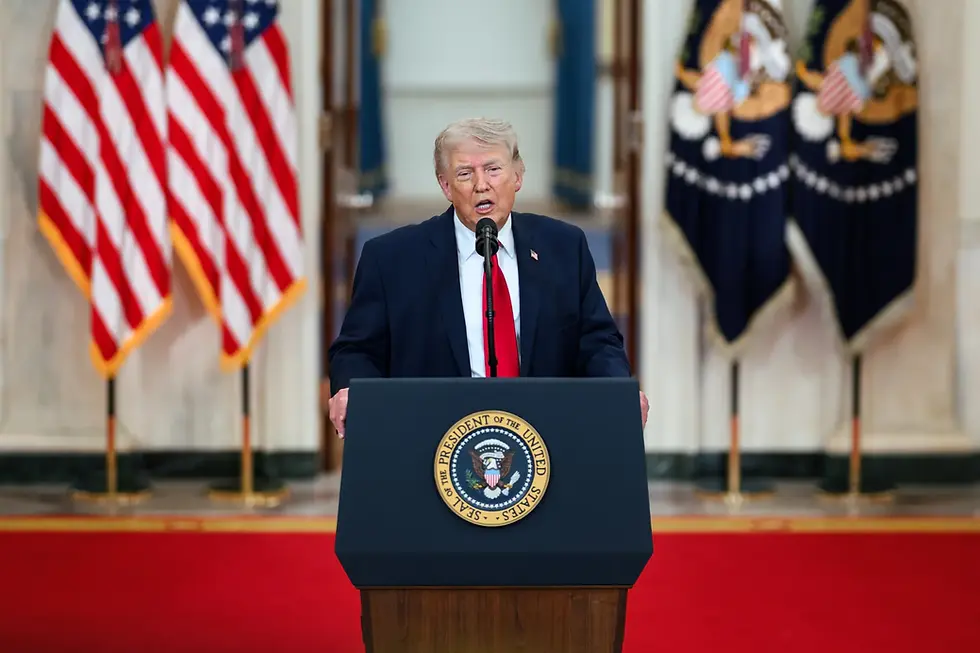
President Donald J. Trump’s foreign policy, so often caricatured as impulsive or crude, reads far more clearly once one accepts that he is speaking an older language. It is not Wilsonian, and it is not post-Cold War managerialism. It is recognisably Roman.
From Ius Gentium to International Law
The ius gentium was never a charter of universal virtue. It was a practical law of peoples, hammered out where Roman power met non-Roman societies. Its function was to stabilise an empire, not to flatter the conscience of senators. Compliance followed because Rome could compel it, and negotiation mattered because Rome preferred order to endless war. International law today pretends to operate in the absence of a hegemon, yet depends entirely on one. When that hegemon refuses to enforce the rules selectively written in its own image, the system decays.
The post-Cold War “rules-based order” tried to reverse the Roman logic. It elevated procedure above outcomes and process above responsibility. Law became a shield for the disruptive, not a discipline imposed upon them. Rogue states learned quickly that the statute book could be weaponised. Terrorism hid behind jurisdictional gaps. Narcotrafficking exploited sovereignty. Hybrid warfare flourished in the grey zones between Article 2(4) sermons and Article 51 evasions. Chaos learned to dress itself in legal language.
President Trump’s instinct has been to puncture this illusion. He does not treat international law as sacred text. He treats it as a tool that has outlived its purpose. Caesar would have recognised the move.
Asymmetry as Strategy
Power is not measured by how often one fights, but by how quickly others decide not to. The striking feature of Trump’s posture has been asymmetry. Russia has been mired in Ukraine for years, bleeding men, matériel, and prestige in a grinding war that exposes the limits of Moscow’s strength. China watches closely, because Taiwan is not a soft target and never was. It is armed, prepared, and integrated into a network of interests that would make any assault ruinously expensive.
Against this backdrop, President Trump’s signalling has been brutal and effective. Where adversaries rely on protracted attrition and legal obfuscation, he emphasises speed, clarity, and overmatch. The message is not that America wants war, but that it will not outsource deterrence to communiqués. In strategic terms, the contrast is devastating. One side demonstrates that force bogs down; the other demonstrates that it ends arguments.
This is not recklessness. It is pedagogy.
Hybrid War Meets Hard Power
Hybrid warfare is not a deviation from international law; it is the way in which international law has been hollowed out and repurposed by those who despise its stated aims. Rogue states have learned that the language of sovereignty, jurisdiction, and procedural restraint offers protection rather than discipline. Law no longer constrains their conduct. It immunises it. Terrorist organisations are sponsored, armed, and sheltered under the cover of formal statehood. Narcotrafficking networks are tolerated or actively managed by regimes that posture as victims of Western coercion. Criminals are harboured, money is laundered through compliant jurisdictions, and violence is outsourced to militias precisely because the system treats indirect aggression as a lesser offence.
International law, in theory, prohibits all of this. In practice, it supplies the alibi. Every response is delayed by process, diluted by multilateral consultation, or neutralised by claims of non-interference. Hybrid war thrives in this procedural fog. It assumes that liberal democracies will litigate themselves into paralysis while their adversaries exploit the gap between norms and enforcement. The result is a world in which the most cynical actors are the most protected.
President Trump’s response has been to reject the premise that accountability must wait upon universal consent. He treats hybrid warfare as warfare, not as a regrettable legal ambiguity. When regimes use terrorism as an instrument of statecraft, he refuses to dignify the distinction between proxy and principal. When narcotrafficking becomes a strategic revenue stream, he treats it as a national security threat rather than a policing inconvenience. When criminals are sheltered by sovereign flags, he treats sovereignty as forfeited rather than sacrosanct.
This approach offends a legal culture that has confused restraint with virtue. Yet it is precisely the unwillingness to escalate that has allowed escalation by other means to become permanent. Trump’s critics accuse him of militarising foreign policy. The more accurate charge is that he is remilitarising deterrence after decades of juridical evasion. He is restoring consequences to actions that have been insulated from them.
The deeper problem lies in multilateralism itself. What once functioned as a mechanism to manage power has curdled into a political forum defined by grievance. Institutions that claim neutrality now operate with ideological hostility toward the West, treating American power as inherently suspect while excusing authoritarian conduct as cultural difference or historical compensation. Votes replace judgement. Majorities replace legitimacy. Procedure replaces responsibility.
This is not multilateralism as coordination; it is multilateralism as obstruction. It does not resolve conflict but diffuses blame. It does not restrain violence but rewards those who outsource it. President Trump’s denunciation of this system is not nihilistic. It is diagnostic. He is addressing the failure of an imaginary international law that exists only in public relations, and a militant multilateralism that has lost both moral seriousness and strategic purpose.
Caesar dismantled legal fictions when they ceased to serve order. Trump is doing the same. He is reminding allies and adversaries alike that law without enforcement is theatre, and that a system which protects aggressors while sermonising victims deserves neither reverence nor obedience.
International Jurisdiction Without a Moral Compass
Multilateral institutions were once designed to manage victory and prevent its abuse. They have evolved into something else. Too often they function as theatres of resentment, where blocs defined by grievance rather than responsibility rehearse their opposition to Western power. Neutrality has been replaced by performative moralism, and procedure has become an end in itself.
International jurisdiction illustrates the decay. The International Criminal Court, conceived as a last resort against atrocity, has drifted into selective activism and procedural excess. Its processes are elaborate, its accountability thin, and its political instincts transparent. Law that aspires to universality but enforces itself asymmetrically becomes parody. President Trump’s contempt is not for justice, but for the fetishisation of process divorced from legitimacy.
Rome dismantled institutions that ceased to serve order. It did not apologise. President Trump should not do so either.
Greenland and the Geography of Reality
Greenland is not a provocation; it is a map. Its strategic value lies in what Europe prefers to ignore. The Arctic is no longer a frozen periphery but an active theatre, one in which Russia has rebuilt military infrastructure at speed and China has declared itself a “near-Arctic power” with investments, research stations, and dual-use ambitions that thinly veil strategic intent. Sea lanes are opening, undersea cables are multiplying, and missile trajectories still obey geography. Greenland sits at the hinge of all three.
President Trump’s bluntness on Greenland was a refusal to indulge a European fiction: that the island’s security can be guaranteed by administrative sovereignty and polite assurances. Denmark does not possess the military capacity to defend Greenland against a peer adversary, and no serious strategist pretends otherwise. The security guarantee, such as it exists, is American. President Trump merely said aloud what NATO planners have long assumed in silence.
The reaction from Europe was revealing. Rather than confront the reality of Russian militarisation and Chinese encroachment in the High North, European politicians chose theatrical indignation at Washington. Fantasies about “defending” Greenland from the United States were aired with a straight face, despite the absence of any credible European force posture capable of operating in the Arctic at scale. It was posture without power, rhetoric as substitute for responsibility.
This pattern is not new. Europe remains strategically idle before Moscow’s aggression and Beijing’s expansion, yet reflexively hostile to American assertiveness. It is easier to moralise against the ally that underwrites security than to challenge adversaries who impose costs. The result is a managed decline dressed up as autonomy: dependence rebranded as dignity, inertia sold as prudence.
Trump’s intervention cuts through this charade. He is not threatening Greenland; he is demanding that Europe stop pretending the Arctic is a seminar topic rather than a battlefield in formation. His message is not imperial but corrective. Power will organise the region one way or another. The only question is whether Europe intends to participate in that organisation or continue outsourcing reality to Washington while denouncing it for noticing the map.
A Different Conversation with Moscow and Beijing
President Trump speaks to Putin and Xi in a register they understand. It is not the language of resolutions, but of consequences. Deterrence is restored not by incantation but by credibility. The dismantling of a dysfunctional order does not mean an absence of order. It means replacing a system that rewards obstruction with one that penalises it.
The Roman parallel matters because it clarifies the aim. The goal is not perpetual war, nor is it utopian peace. It is a negotiated stability anchored in power. The ius gentium worked because everyone knew where Rome stood. Trump’s foreign policy, stripped of commentary and caricature, seeks the same effect.
An Old Ending
Caesar closed his campaigns not with apologies, but with settlements. Trump, for all the noise, is doing likewise. He is reminding a disordered world that law follows power, not the other way around. Those who prefer the comfort of imaginary rules will call this barbarism. History suggests another word: governance.
Bepi Pezzulli is the Political Director of Italia Atlantica. He is a Solicitor in England & Wales and an Avvocato in Italy. A foreign-policy scholar, he is a councillor of the Great British PAC and Britain Unbound. He tweets at @bepipezzulli.


Comments